

A very exciting day today, with many hundreds of concrete sleepers distributed beside the track, most of those dropped off the train yesterday infact. Unfortunately this is one job that does seem to take an age, running backwards and forwards, even using the trolley it still seems to drag on forever! Anyway, only many many thousand to go now. We’ll likely make this a summer job on days when it’s too hot to do much else.

The gang spent their time collecting, stacking and banding up the gluts, which in itself takes a while.
We then moved on to stacking up old removed sleepers by Sawmill Rd for disposal.

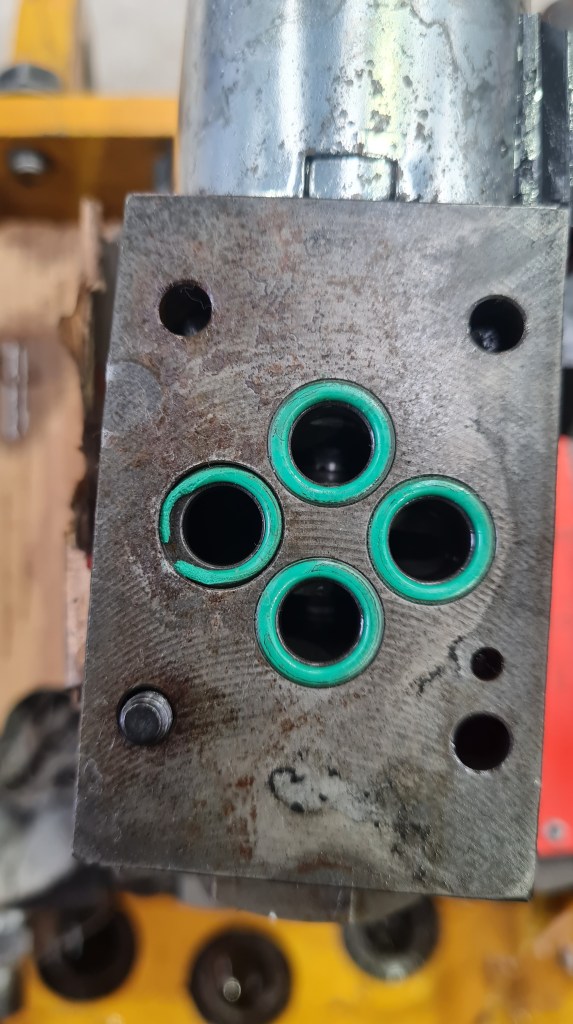
In unrelated matters, the little digger has had its rotating head removed to assess the source of the leak. This little O ring seal on the grab circuit valve block was all it was. Fortunately, accessing it is most of the battle. The fixing it is quite straight forward now.
Thursday’s crew will meet out at Boundary Track from 8.30am, where we’ll have a big clean up of all the mess from there down to where we’ve installed sleepers so far.
 VGR Civil Blog
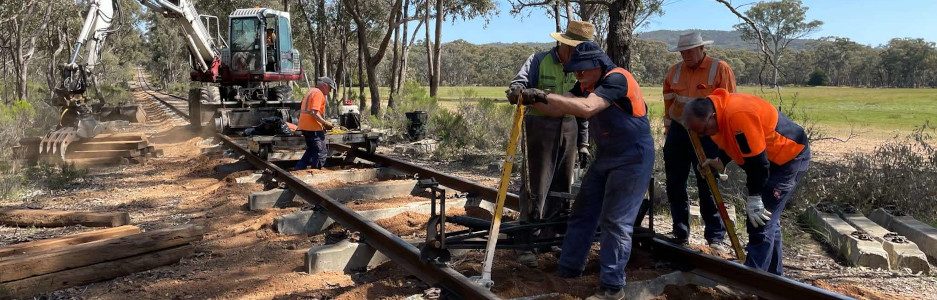
I was under the impression that concrete sleepers has already been placed in the entire track on a 1 in 3 basis and that the intermediate timber sleepers were being replaced on life expiry. Obviously I was wrong, as the picture shows virtually all timber sleepers together with an odd steel sleeper. With the number of concrete sleepers laid out, I get the impression that you are now going for full replacement on this section of track.
What is your strategy from here? Full replacement or 1 in 3 replacement etc or a combination of both strategies depending on the condition of individual sections of track?
LikeLike
You’re certainly not wrong in your observations, however the 1 in 3 concretes were purely between Muckleford and Castlemaine (half the line) the other half has essentially no concrete sleepers in it at this stage.
Only certain types of concrete sleeper can be interspersed with timber sleepers successfully – these are the type we’ve used Muck to Cast and are hopeful that we’ll be able to acquire sufficient numbers of these to allow this section to be 100% concrete over time in an as required type fashion.
However that sleeper type is quite scarce (in terms of being disposed of), but the Full Profile type is relatively readily available – but only successfully used when replaced 100% – as such the plan is quite simply to work through Maldon to Muckleford replacing 100% of the timber with concrete (it’s all to do with the physical height of the sleepers). If we suddenly find an influx of the low profile / timber mixable type sleepers again, this may change back into a 1in3 or 1in4 pattern in places as suited to the location, however on the whole the plan is pretty much as listed above.
LikeLike
Thank you for the very comprehensive reply. The blog is an excellent ongoing record on the track maintenance and upgrading efforts of the VGR.
Interesting dilemma you face, regarding the availability of low profile vs full profile sleepers and how you best utilise both types. Get it wrong and you run the risk of not getting enough low profile sleepers to keep up with required timber replacements on the 1 in 3 / 4 section. In this case you may either be forced to replace timber with timber or replace a portion of the 1 in 3 / 4 section with full profile in order to obtain further low profile sleepers.
LikeLike
Thankyou!
Yes, that is certainly very much in our sights. We’ll be focusing on replacing the most crucial areas with the low profile sleeper 100% (curves, awkward locations, places not suited to full profiles for various reasons – we almost have enough in stock currently to achieve that) in-case we do end up having to do a total replacement in the easier sections (straights with good access) based on what is available
LikeLike