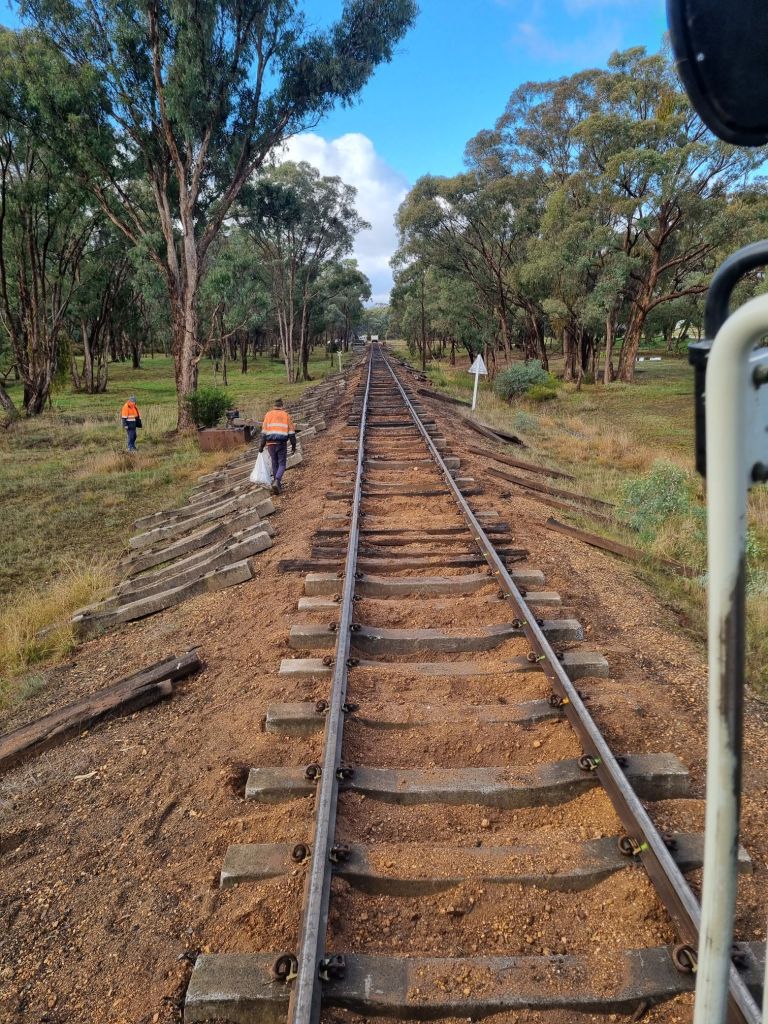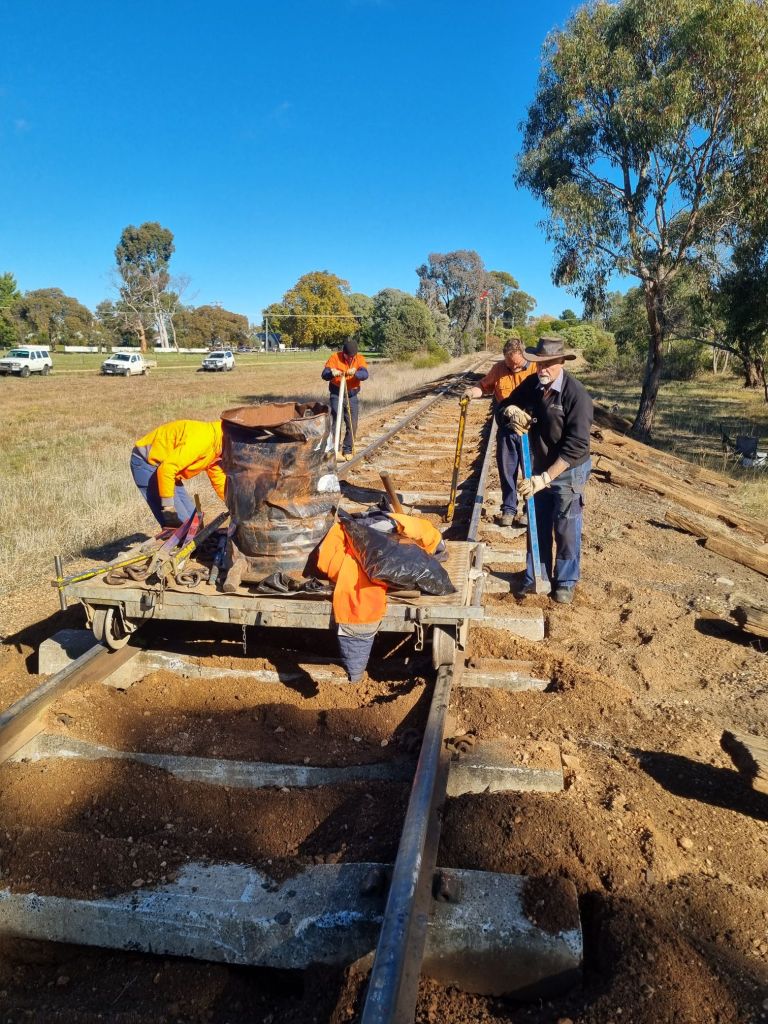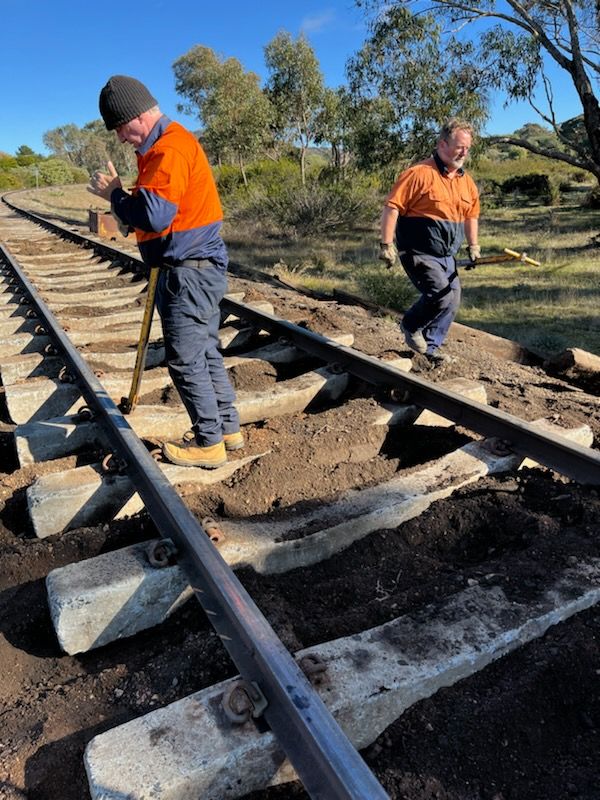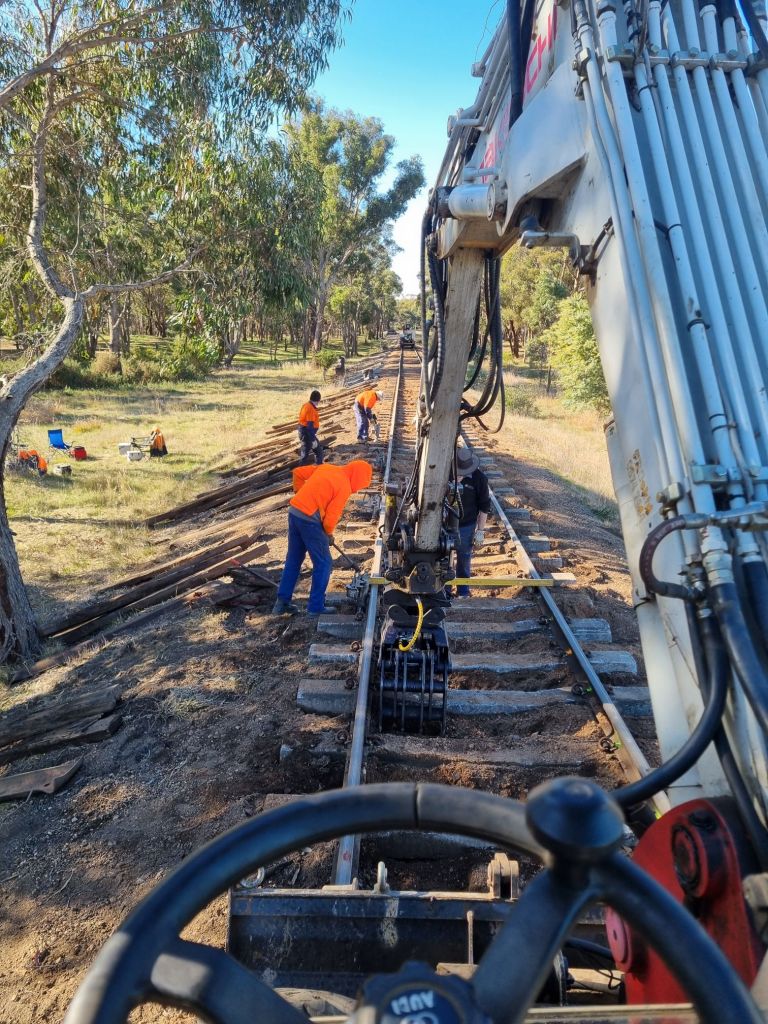
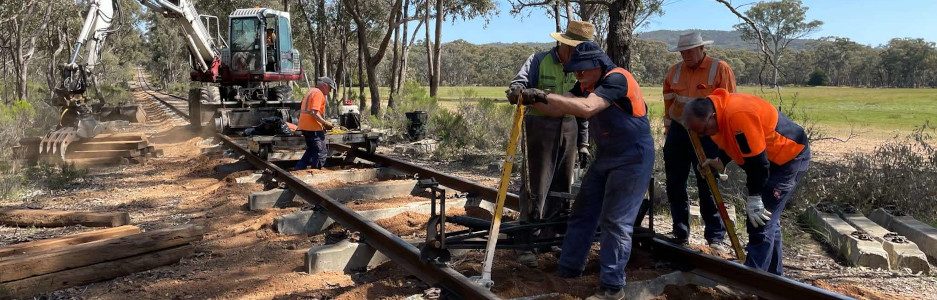
Our day was focused very heavily on tidying up and preparing to install the final dog spikes tomorrow.
However in exciting news… we had to yield our use of the track for this to pass through….
A very bright, shiny and impressive J549 undergoing its first mainline run in just under 500 days!
We enjoyed watching it pass over our recent work at the Bridge so much that on our way back to the Maldon Depot we offered our cheers of support to the loco as it passed over the section of concrete sleepers we completed a few weeks ago.
It was a very impressive sight, sound and like welcoming back an old friend!
Check out the Mechanical blog and the VGR Facebook Page for all the exciting details.
We did do a working test of all the facilities, such as water columns and turntables that haven’t seen much use for 17 odd months, everything behaved perfectly (although we did do a full check over and some minor repair work to both in the previous week in anticipation).
Tomorrow’s gang will have the very exciting task of drilling holes and installing dog spikes, it’s not great fun however it is very literally the last hoorah in regards to rerailing on timber sleepers (the crossing at Sawmill Rd will likely be all concrete so hopefully this will be the last large scale timber sleeper drilling/spiking for some time).
It was a long, hard day’s work today. However, all the remaining sleepers on Winters Flat Bridge have been drilled and spiked. Believe it or not, this took almost all day.
There was a fair time this afternoon however, when we couldn’t effectively use any more than 2 people at a time on the bridge, so we dropped out and subsequently inserted all the sleeper plates in the section off the bridge, which is approximately the length of the bridge also by coincidence.
We did have a logistical error in the location of the gang truck and more importantly the chairs for the meal breaks today…. this resulted in some interesting alternatives being devised by the crew!
A keen eye might even note that the Takeuchi excavator is back in action, the part has been repaired and refitted, and it’s back behaving as it should! For how long is anyone’s guess, but we’ll give it a good test this week as we have sleeper changes and tamping to complete.
Tomorrow’s gang will meet out on site from around 8.30am, where we’ll have a bit of a change of pace and break up as much of the 60lb as we can as there isn’t really anywhere appropriate to stockpile long lengths near the bridge.
First thing this morning and the down leg particularly had snapped into a very good line, requiring only minor tweaking to get it looking very nice.
The photograph was a bit slack again today, so no real action shot, but there after shot of the down leg, we’re really impressed with how it came up.
A good amount of time was spent doing a rough line off the bridge also and this has certainly improved the appearance greatly.
By day’s end, both legs were tied up at least 1 in 4 sleepers (equivalent to 1 in 3 anywhere else as the sleeper spacings on the bridge are far closer than elsewhere), we’d finished clipping up everything off the bridge and even run a light engine over the bridge to just prove that it would be satisfactory for the weekend, and its as solid as a rock, not any hint of movement and rides silky smooth (no photos unfortunately).
We’re still having trouble with the level crossing, however we’ve got a temporary solution to get us through the weekend which we’ll review next week once we’ve researched a little more closely on this exact make and model!
There won’t be a workday on Monday, however Tuesday will be a goer, meeting Maldon 8am or out on site, the bridge again, from 8.30am.
Well… after another big effort today, the last of the 60lb on and around Winters Flat Bridge has been replaced with 80lb.
Thankfully, there are many photos of the works today, which was essentially a carbon copy of yesterday.
It began with a reminder/refresh session on the safe use, checking, adornment of harnesses, and the rail-sliders. Once everyone was again familiar with the equipment and its correct use, we headed out to start the job.
It began by dropping out sleeper plates and removing all of the inside screws, leaving all outside screws for the time being.
The reason for leaving the outside screws was to allow for much easier extraction of the outer screws, having a much larger flatter area to stand upon, without the rail getting in the way. This was achieved by having the digger travel back over the trackwork to flick the 60lb slightly away from the remaining screws, enabling an easy pull of the rail off the bridge without snagging the fishbolts on screws, this was done in two halves to lessen the chance of any snagging, given the long strings of rail had to go around a curve once off the bridge.
Once that was gone, the screw removers returned to take out all the outer screws, with the digger then placing the new rail roughly in position as it worked back across the bridge.
All the while we had spotters at various locations below the bridge to keep an eye on any potential falling rocks and you’ll be happy to know we didn’t have anything fall (not surprising as there was no need to touch the ballast near the kerb).
Once in, it looked very smart, however it was time to install the sleeper plates.
This was a very time consuming task, as the digger sits well ahead, lifting the rail just high enough to insert the plates under and then resting it down again, before repeating the process, approximately every 10 sleepers. (There is a lot of sleepers on that bridge).
Once all plates were under, the sleepers screwed on the Down Leg yesterday to the reference marks, were gauged and screwed, as this helps ensure before cutting the closure, that there isn’t excess rail on the bridge.
In the meantime, however, the closure was being prepared, the piece of rail we had was back to front, so that needed to be taken well away to a roomier location for turning around.
Once facing the correct way, it was dragged back down to the site and cutting began.
One end was cut, drilled and plated up ready for the final length measurement once the crew on the bridge were done screwing up.
Once the final screw was in, the whole big long length was given a good tug to pull out any slack, around 10mm was gained by this so it shows how easy it can be to get too much rail in a section.
Before long however, it was all joined up and looking, well still pretty twisty. This is not surprising as only about 12 sleepers are pinned to the rail for the whole length of the bridge, and given we were now in the warmest part of the day, the rail will grow enough to get a little wiggly between the fixed points. However now that it’s bolted up, the cool of tonight will see all of those wiggles straightened out to an almost perfect straight line (we tested this theory on the Down Rail Yesterday and it worked perfectly!). So we’ve saved all the screwing down for tomorrow morning, when the job will be much easier!
We called upon the signals branch today to reinstate the diode at the new Insulated Joint. The diode is bolted through a Cembre, effectively a swagged piece of aluminum through a hole drilled in the rail, the little machine is the swagger.
Gary came out to undertake this work and ensure everything worked as a result of the recent re-railing, which unfortunately it doesn’t quite, we’re still chasing our tail on this one as the issue doesn’t seem to be with our work, rather up at the box itself, so we’ll no doubt get that resolved tomorrow.
The diode was also replaced with a new one and buried appropriately to ensure its safety.
By the end of the day, we were extremely proud of our efforts, with only a few hours’ work remaining to complete the track over the bridge tomorrow, at least to make it safe for trains this weekend with a speed restriction, however it’s quite likely we’ll get the whole thing tied up.