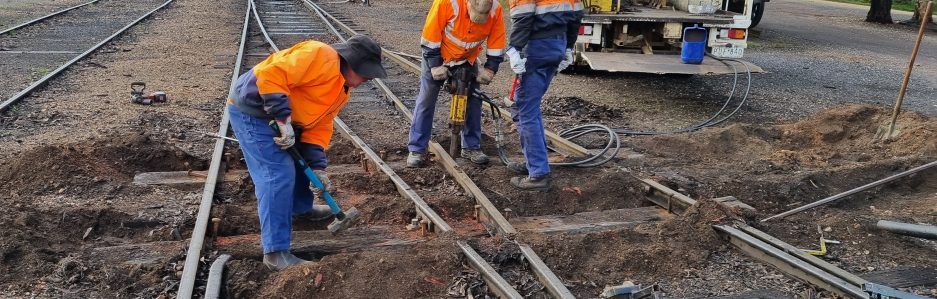
Back to Castlemaine Loco Shed

Thursday (7th April) and Friday (8th April) saw us back at Castlemaine working towards getting track into A and B Roads in the new Loco Shed. The last time we worked here was two weeks ago and our plan was to get both tracks into the shed and useable.

Two weeks ago we joined the rails up for A Road but didn’t finish clipping them to the concrete sleepers. So that was the first task.

Thursday (thanks to Bruce for today’s photos)

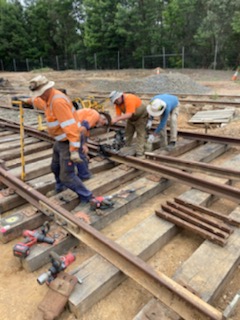
Clive and Mal lay out clips and spacers (‘biscuits’) ready for clipping the rails to the sleepers while dog Jack supervises with John and Rolf’s help.

Once that was finished, it was time to lay out sleepers over the heritage pit in B Road. This pit will eventually have timber coping around the top and the rails fastened direct to it. The concrete sleepers are a short term expedient.

John lays out the sleepers over the pit in B Road while Clive, Henry and Mal stand ready for any fine adjustment needed.

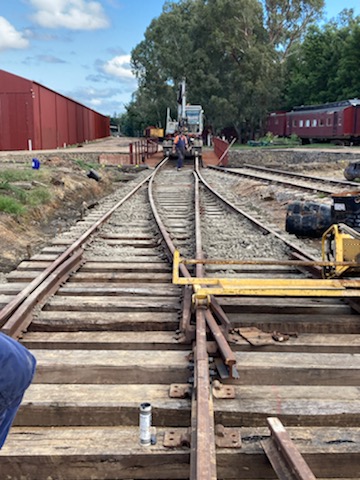
Back outside, more of the team prepares to join the previously laid turnout to B Road.
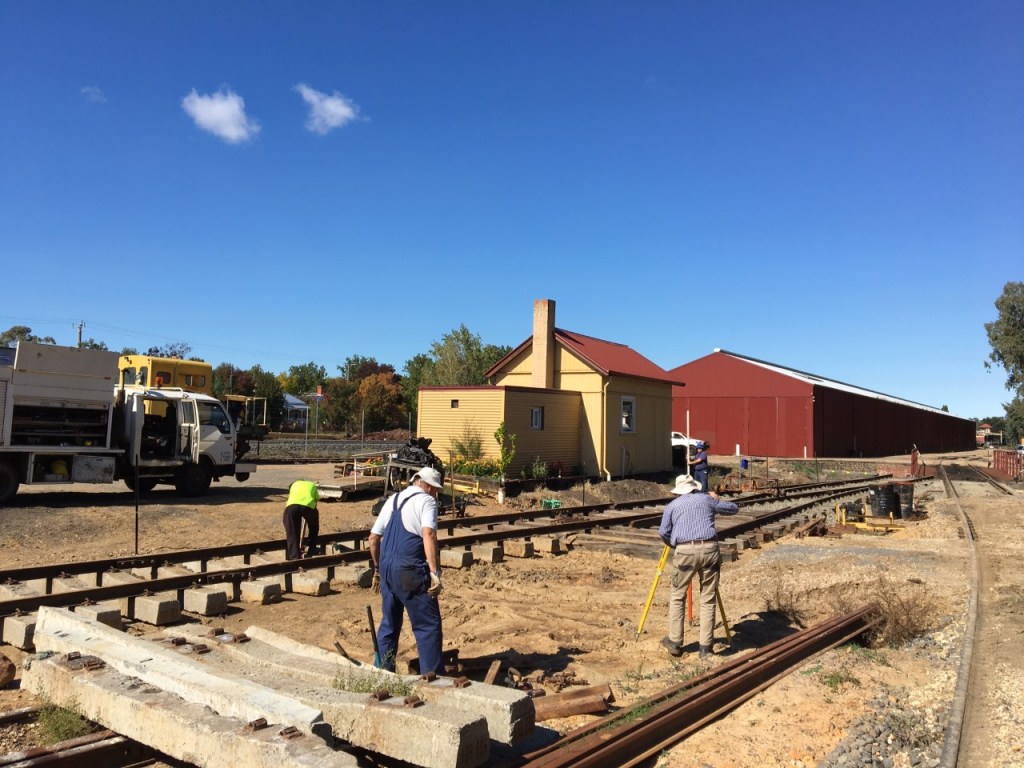
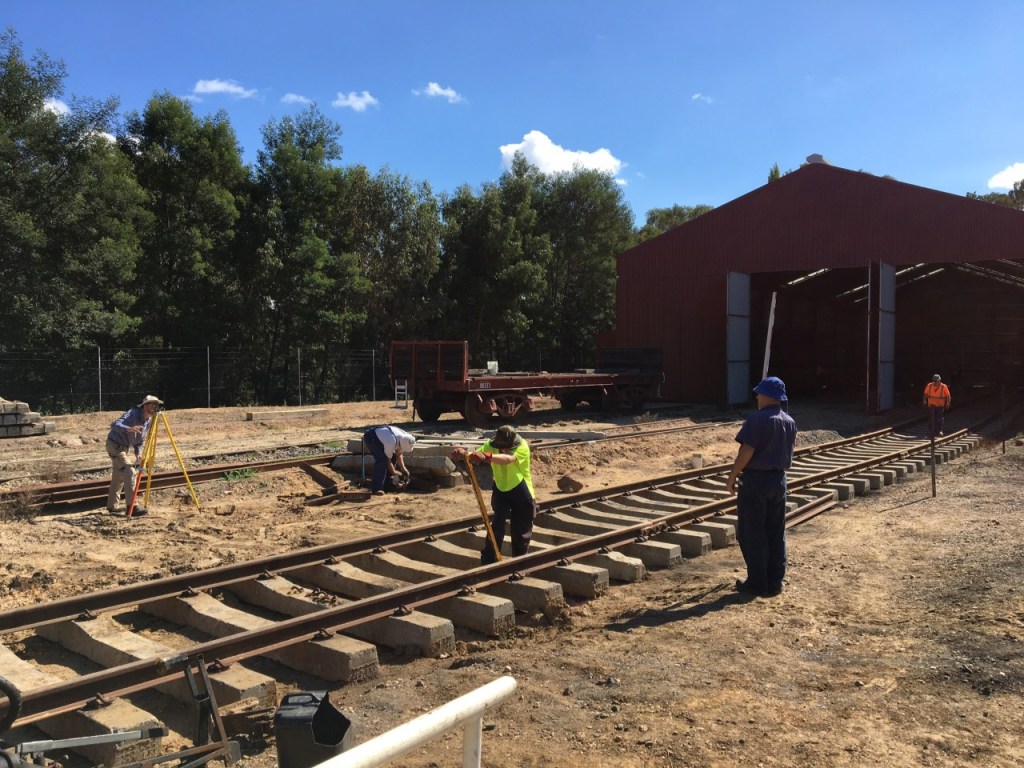
Rolf on the theodolite and Artie on the staff, re-survey the centreline for B Road, while Henry finishes off clipping up A Road and Graham prepares fishplates for the track-laying.
Another view of Rolf, Graham, Henry and Artie hard at it.

In the meantime a new acquisition in the form of rail tractor RT 31 has been delivered and is now patiently awaiting the completion of the track work to find its way into the loco shed.
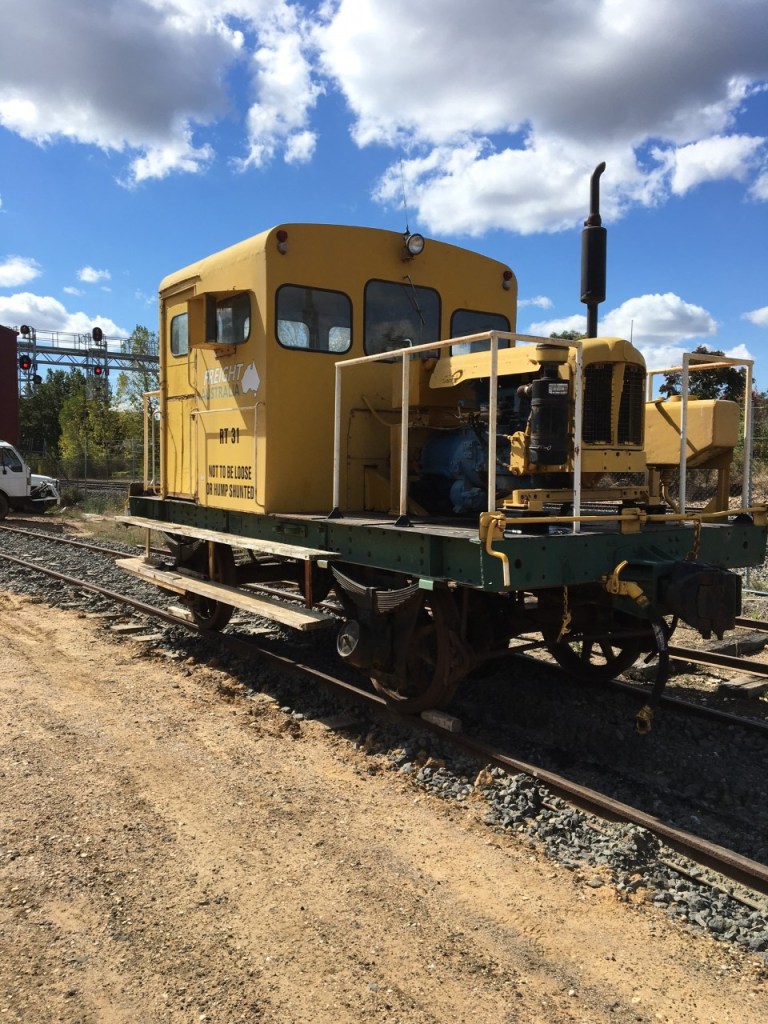
RT 31 looks almost ready for work.

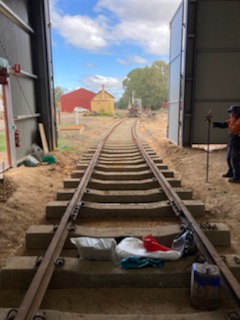
Back in the loco shed, the sleepers have all been laid out over the pit and preparations are under way to lay rails on them.
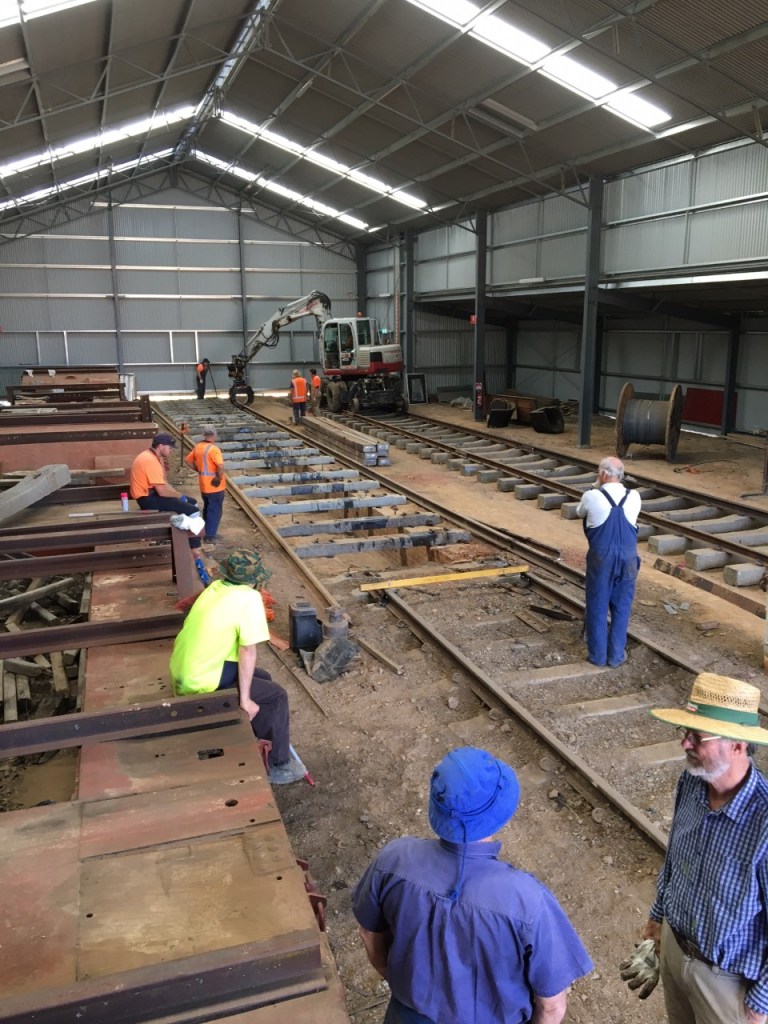
John in the excavator is about to lift the right hand rail into place. Will and Henry rest a little on the well wagon on the left while Mal, Clive, Ian, Norm and Graham are ready to assist. Artie and Rolf Discuss the next moves in the foreground.

With the right hand rail now in place, the rail is adjusted to give the correct gap for the joint.

Here Clive uses a sleeper plate to give the correct gap as John in the excavator slides the rail towards him.

And finally, the new rail is fish-plated to the existing one and clipped to the sleepers.

Henry, John, Graham and Mal, clip the rail to the sleepers; while Norm, Steve and Ian watch carefully.

Friday

On Friday there was further action. With a team of eight really progresses the job a good way so that there’s only a couple of days work to make the the roads into the shed useable.

The first task was to lift the second rail onto the sleepers over the pit, join it up and clip it down and that was completed ready for use. However there was still a 9m gap outside the shed between the new turnout and the track into the shed. To close it we needed to lay 9m of sleepers and rails and join it all up.

B Road into the shed had previously been laid and connected direct to the turntable, but to connect up C Road meant installing a turnout and now the track had to be re-aligned. The existing track had been buried to provide road access in front of the shed, so shifting it was no small task and way beyond the capability of our little Takeuchi excavator. So in came the ‘big gun’, our 14T Hyundai excavator which had been at Muckleford for last week’s re-railing.
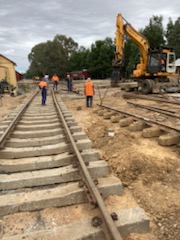
The ‘Big Gun’ on the job.
Ian directing John while aligning B Road to new centre line pegs.
B Road after slewing to line up with the turnout.

By the end of the day, the track was re-aligned, sleepers laid out in the gap and rails made ready for laying on them.

Next Week

We will be working on Tuesday and Thursday next week – next Friday is Good Friday and we won’t be working that day. If you can spare some time on either Tuesday and/or Thursday please call John Shaw on 0427 352 416 and let him know.

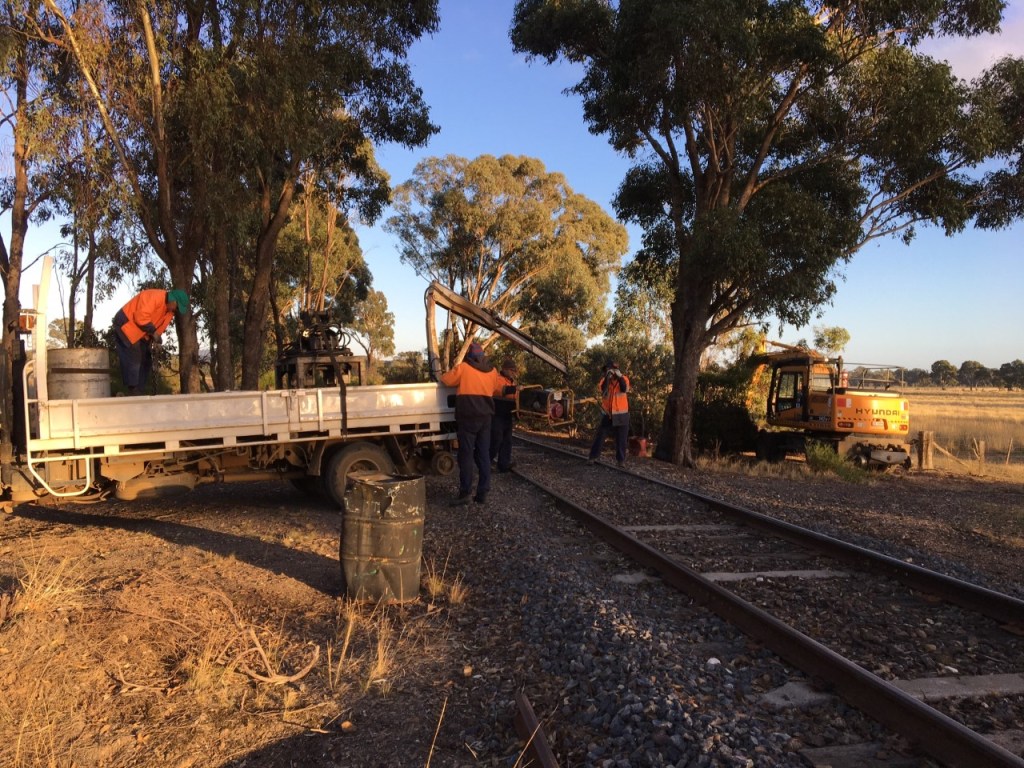
And Over The Bridge!

This week we replaced the rails on the ‘Down’ (South) side of the track where we had replaced the ‘Up” rails last week. The process was the same but we were a bit better prepared this week so it seemed to flow a bit better.

But first – the magnificent sunrise at Maldon station that day! Inspirational – to balance the cold wind blowing.

Once on site, we unloaded the equipment and got right into it.

Unloading the spike puller from the “Yellow” truck – now painted white – but who noticed.

The rails were once again fastened to the sleepers using a mixture of screws and spikes on the timber sleepers and clips on the concrete ones.

Mal undoing the screws.
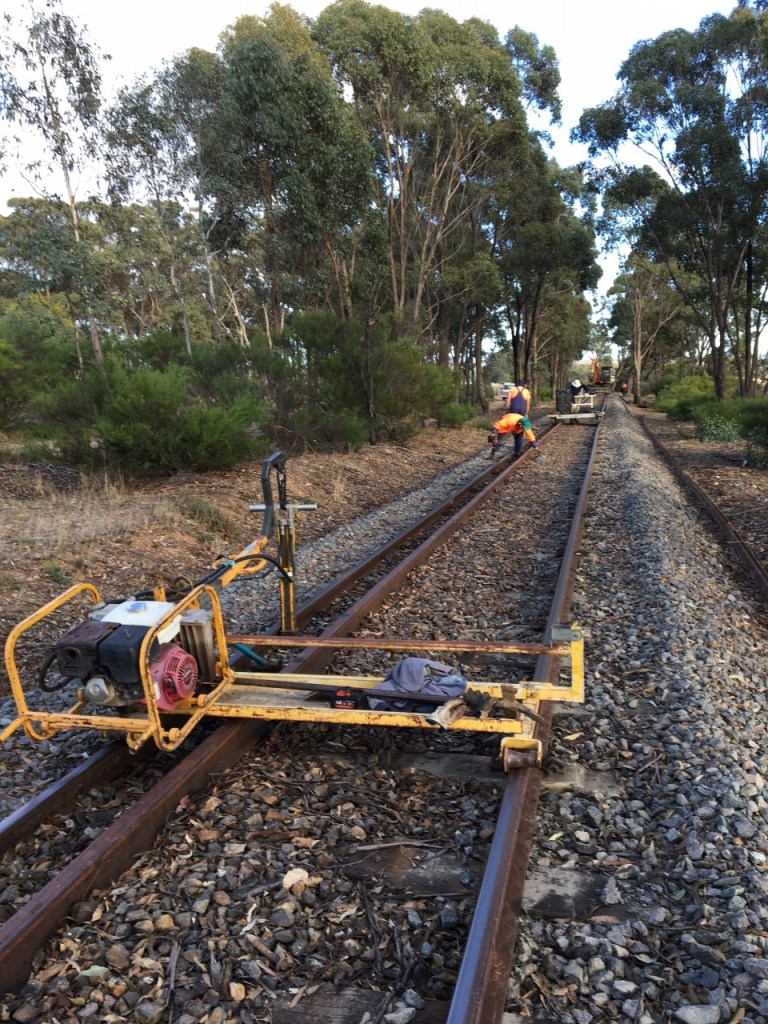
The spike puller – temporarily unmanned while Bruce the operator takes a photo of it.

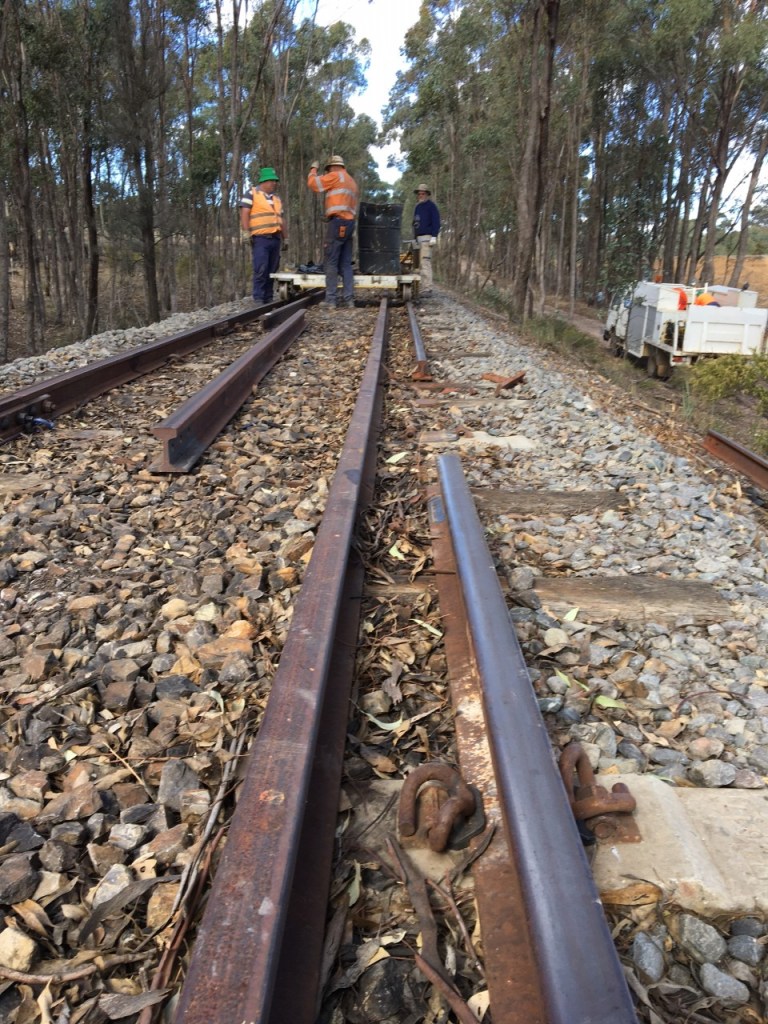
The new rail is all laid out between the old ones.

New rail ready to be installed.

The first job in the actual rail changing was to undo the fishplates holding the rails together where the new one was to go in.

John S, John McC and Clive undoing the first joint.

The old rails are shifted to one side, any ballast or tree debris is cleared out of the way and then the new rail is lifted into position. The new rails to be laid today, go over Bridge 10 (Farmers Bridge).

The old rail (left) has been lifted out of the way and the new on put in its place.

Off the bridge, every third sleeper is a concrete one, so the rail is held in place by a metal lug on either side of it. However, on the bridge all the sleepers are timber, so we put a few screws loosely into some of the old holes to stop the rails moving to under the excavator.

The new rail (right) is about to be moved against the screw standing up in the sleeper to ensure the excavator runs over rails the right distance apart.

Moving the new rails, which weigh about 2.5 tonnes, up to the previously laid ones and leaving the correct gap (to the millimetre) can be quite tricky. On Thursday we tried using a rail grab attached to the arm of the excavator to see if we could do it a bit easier – and it helped a bit.

John S with a radio, talks to John McC in the excavator while the rail is very slowly moved to give an 11mm gap for expansion.

Close behind the excavator is the team clipping the rails to the concrete sleepers.

Mal and Clive get on with the clipping while John S and Murray discuss joining the rails together.

By the end of Thursday we had replaced 275m of rail and clipped it up to the concrete sleepers. Friday’s job was to fasten the rails to the timber sleepers, particularly over the bridge, and join the new rail to the old – ready for tomorrows trains.

The short piece of rail (second from left) will be added to the nearest one on the right and the old rail cut to match it.

Friday’s gang was once again quite small (the gang – not the people!) with just four of us there.

We drilled holes in timber sleepers, installed sleeper plates, Pandrol adaptors and clips and drove in spikes until all the rails we laid on Thursday were securely fastened ready for Saturday’s trains.

We also closed the gap between the new rails and the old, and built a bit of a ramp to take account of the 25mm difference in height between the old rails and the new. We now have just 5,267m of track to re-rail to finish the job between Castlemaine and Muckleford. That’s just 10,534m of rail to go!

Next Week – Thursday and Friday – More track to be laid into the loco shed at Castlemaine. Meet at Castlemaine Depot at 8.00am each day. Please ring John on 0427 352 416 to confirm you are coming- or if you would like to join us for the first time!

Thursday and Friday Re-railing – The Left Hand Rail!

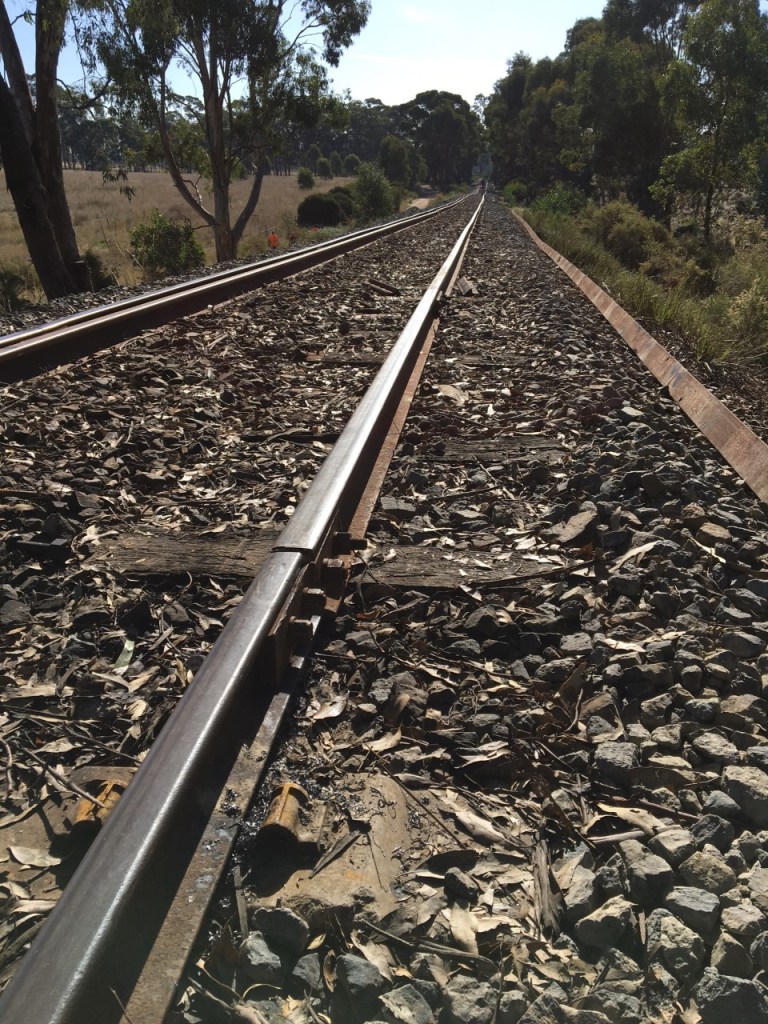
On Thursday and Friday we replaced about 275m of 60 lb/yd rail in 22’6″ lengths (30kg/m in 6.86m lengths) with 94 lb/yd rail in 180′ lengths (47kg/m in 55m lengths).

Task 1 is to unfasten the existing rails – these being held by a mixture of dog-spikes and dog-screws in timber sleepers and Pandrol e-clips in concrete sleepers.

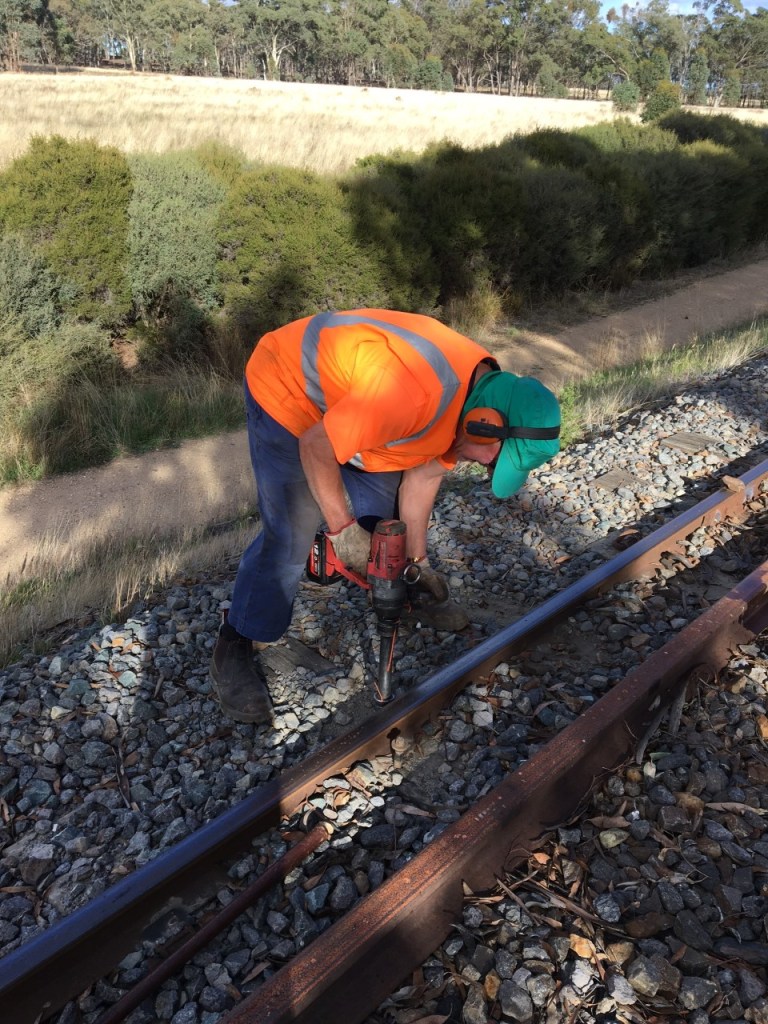
Here Malcolm is undoing dog-screws using an electric impact wrench.
Followed by Graham pulling spikes.

Rolf had gone ahead removing anchors and e-clips – sorry no photo!

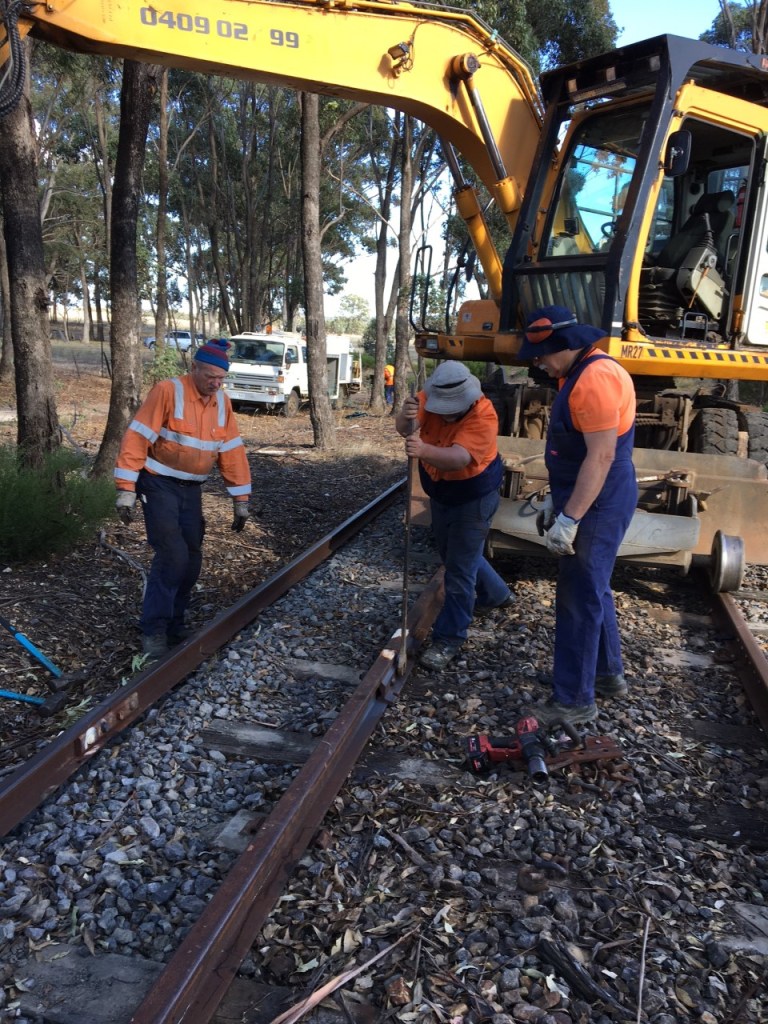
John McC got stuck into using the ‘big digger’, aka Hyundai 140W7, to shift the old rail to one side and move the new rail into place.

John McC swaps his first ever rail while John S “helps”.
The first of the new rails is in place ready for fastening.

The rail ends have to be carefully adjusted to give the right gap to suit the length of the rail and the prevailing temperature. Too much gap and the rail joints might pull apart in winter cold and too little may make the rails buckle in the summer heat. We use a clever ‘pyrometer’ to measure the exact temperature of the rail and then look up a table which tells us how much gap to leave to suit the length of the rail.

Here Graham, Malcolm (hidden) and Norm work on bolting up the fishplates after lubricating them to ensure the rails can move a little when the temperature goes up or down. Clive (left) is checking the remaining old rail.
Up ahead, and John in the excavator is swapping the last rail length for the day, just over ‘Farmers Bridge’, while John on the ground prepares the junction of the new rail to the old.
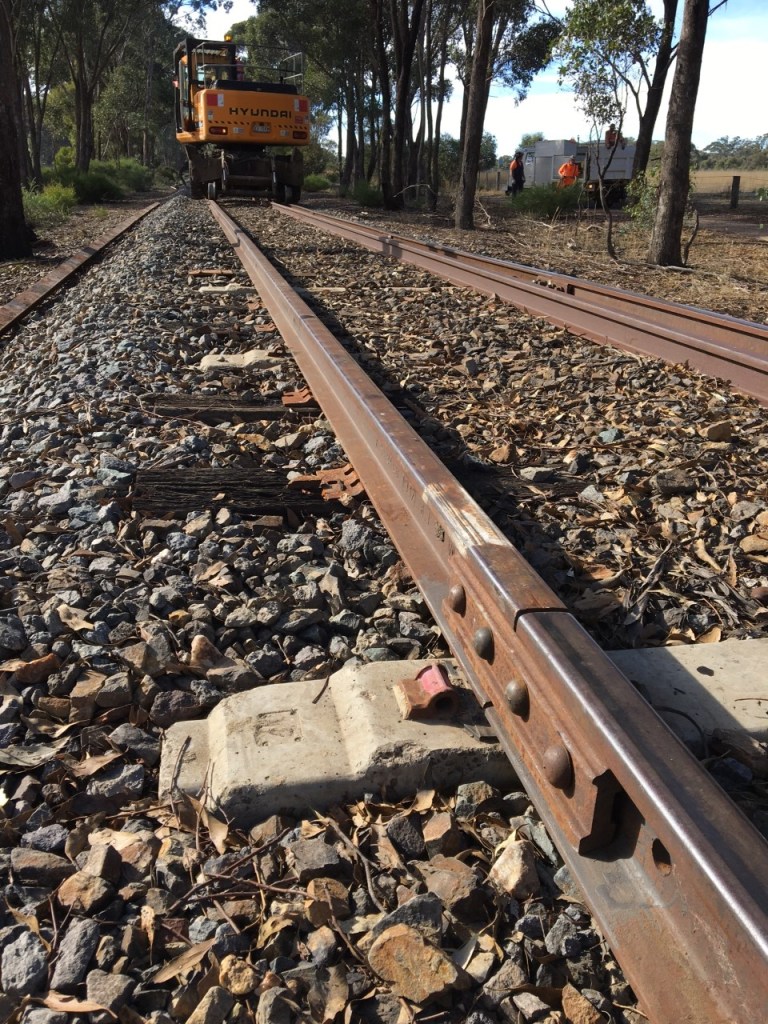
The short piece of rail shown is a junction rail which is a piece of 47kg/m rail welded to a piece of 40kg/m rail. The rail joint in the foreground, where the wide rail head meets the narrow head, is a junction joint from 40kg/m to 30kg/m. This arrangement is needed because there are no standard junction fishplates to join 47kg/m rail directly to 30kg/m.

Friday’s work was to finish fastening rails to sleepers to allow trains to run on Saturday. There were only four of us in the gang on Friday (8 on Thursday) and it kept us going all day. Our job wasn’t helped when our hydraulic dog-spike driver malfunctioned and we had to revert to driving dog-spikes using sledge hammers. Nostalgia is all very well, but we much prefer the mechanical method over the old and very tiring way of doing things.

Our small gang on Friday was a reflection of the age we live in and the age of our team. One was away with Covid, two were in hospital under repair, (not because of trackwork!), and one was away attending a funeral. We look forward to seeing you all back soon. If anyone would like to come and try track work you would be welcome. No special knowledge or skill is required and as you can see, you don’t have to young or fit!

Sorry there were no photos, but our usual photographer was under repair on Friday.

Next week we will be back at the same place, replacing the rails on the other ‘leg’ of the track.

Next Week – Thursday and Friday – Re-railing over ‘Farmers Bridge’. Meet at Muckleford at 8.00am each day. Please ring John on 0427 352 416 to confirm you are coming- or if you would like to join us for the first time!

Into the Loco Shed

On Friday we connected the track from the turntable to A Bay in the Loco Shed – almost ready for locos.

John and John finishing off screwing down points

Our first job was to finish off the pointy end of the turnout – we ran out of the right screws yesterday!

Trevor and John cutting and drilling rails to bridge the gap.

Fitting a ‘closure’ rail between two sections of track takes a lot of care and we had four to do.

Mick hard at work with a paint brush, lubricating the ends of rails before joining them.
John, Trevor, John and Rolf drilling, bolting and clipping rails before screwing them to the timbers.
Here comes the excavator to move some rails.
The track is joined up but not finished, but good enough for the Excavator to run over.

And to prove its good enough –

In the door it comes.

Another successful day but with quite a bit to do before we finish it.

Next Week – Thursday and Friday – Re-railing towards Farmers Bridge. Meet at Muckleford at 8.00am each day. Please ring John on 0427 352 416 to confirm you are coming.